
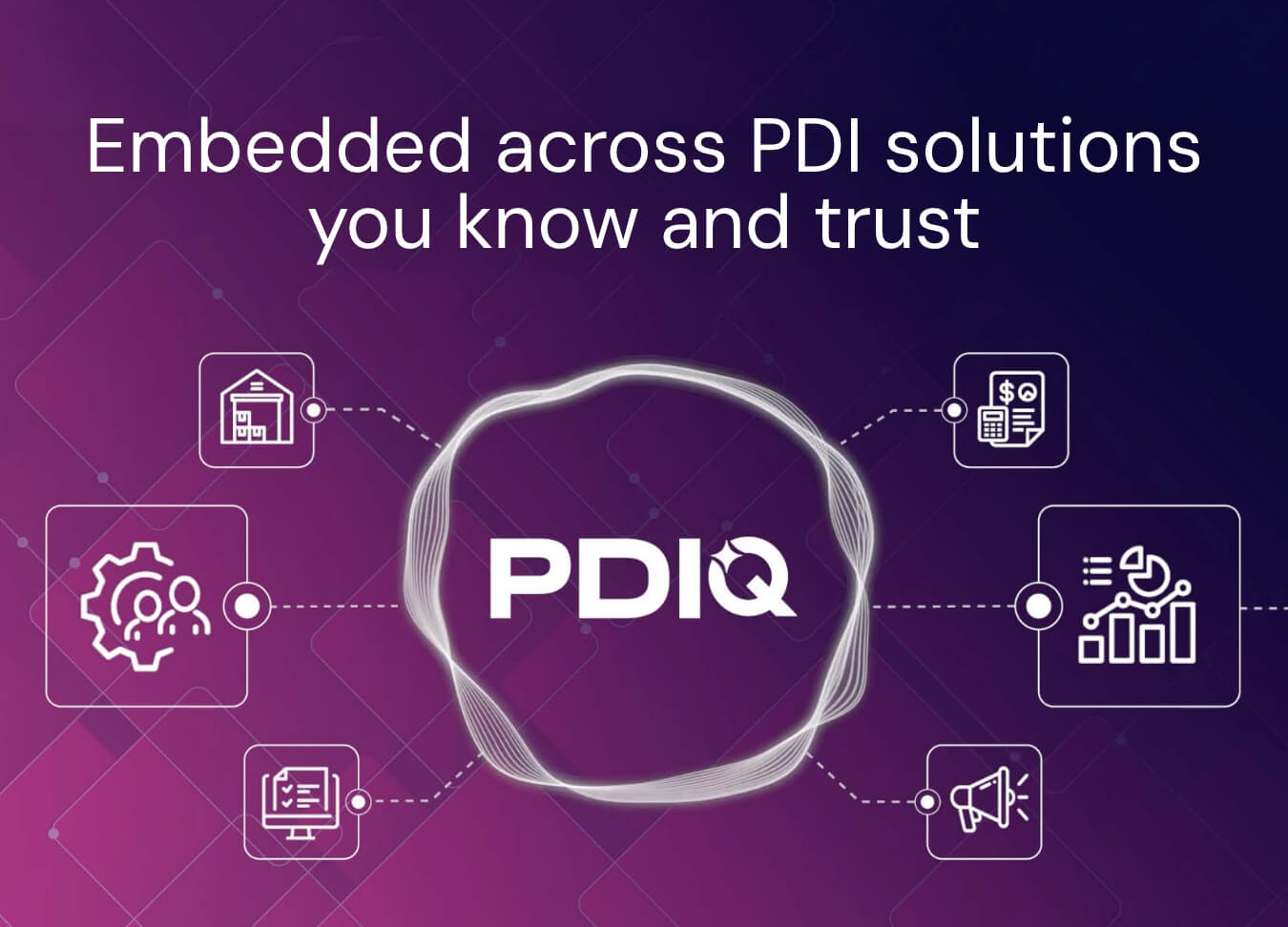
In most platforms, AI shows up as an add-on rather than a native capability. It lives in its own interface, uses a separate copy of data, and operates without much awareness of a user’s role or permissions. It might generate answers or suggestions, but it rarely participates in the actual work happening inside the system.
In contrast, PDIQ is designed to operate within the same familiar identity, data model, and workflows your teams already use on a daily basis.
As part of the PDIQ Insider blog series, this post dives into the architecture behind PDIQ and its impact on how the platform behaves in real operational environments.
Where typical AI integrations tend to break down
When AI resides outside the core platforms you use, a few consistent issues tend to emerge:
- Identity gaps: AI doesn’t fully inherit the user context, which makes it difficult to act on behalf of that user in a reliable way.
- Data drift: AI often depends on exported datasets or indexed copies that lag behind the official system of record.
- Permission mismatches: Without direct integration into access controls, AI either exposes too much or becomes overly restricted.
- Disconnected workflows: AI can suggest an action, but someone still has to move that action into the system where it actually happens.
In convenience retail, fuel, and logistics environments, these aren’t minor inconveniences. When pricing, inventory, or site-level operations depend on real-time accuracy and strict access controls, any level of disconnect introduces inefficiency and risk.
The structure of PDIQ
Those challenges are precisely why we designed PDIQ with four core capabilities built on a shared foundation:
- Front door: A unified entry point with a single identity. Users move across capabilities without losing context.
- Analytics: Reporting, dashboards—available within PDIQ or embedded into other PDI applications.
- Workflows: Orchestrated processes that connect PDI systems, people, and decisions—including triggers, approvals, and automated actions.
- Agents: Task-specific and multistep AI capabilities that operate against real operational data.
Note that these PDIQ capabilities operate on the same underlying systems for identity, data access, and execution. Rather than being an isolated component, AI participates directly inside analytics queries, workflow steps, and operational tasks.
A shared governance layer
For safety, all four PDIQ capabilities rely on a single governance and security layer that handles:
- Authentication: Confirming user identity
- Authorization: Enforcing role-based access
- Auditability: Recording actions and outcomes
Because this layer is consistent across the platform, AI actions follow the same rules as any other system action. There isn’t a separate permission model or parallel audit trail, because the same controls apply everywhere.
AI inside workflows
Workflows are where this architecture becomes tangible. A workflow in PDIQ is a sequence of steps, such as:
- A trigger (event, schedule, webhook, or manual start)
- Data retrieval and processing
- System integrations
- Decision making and outcomes
AI agents appear as one type of step in that sequence, operating in line with the rest of the processes. Consider this example sequence:
- A workflow pulls live operational data.
- An agent evaluates or generates output (classification, summarization, draft response).
- A human reviews, if needed.
- The result is written back to the originating system.
Everything happens within one orchestrated flow: no context switching, no manual copy/paste, and no separate integration path for AI.
Data and access permissions
Because AI runs within the platform itself, it uses the same data access model as everything else. When a user interacts with an agent or submits a natural language query:
- The request runs under their identity.
- The same permission rules are applied.
- Results are limited to what that user is allowed to see.
This is especially important in multisite or role-based environments. A user responsible for a subset of locations sees only their own data—AI doesn’t expand or bypass that boundary.
A foundation of open components
To avoid complexity, PDIQ leverages widely adopted, open components across:
- Data storage and querying
- Analytics and visualization
- Workflow orchestration
- Agent frameworks
- Identity (OIDC-based)
The advantage to this approach is that open standards help ensure each layer—data, workflows, and AI—can interact directly without translation layers or proprietary constraints. It also means that AI operates within the same ecosystem as the rest of the platform.
What this means in practice
For teams working with PDIQ, a few beneficial patterns emerge:
- Less integration overhead: AI uses existing connectors and workflows rather than introducing new ones.
- Consistent governance: Every action—manual or automated—is governed the same way.
- Fewer context switches: Intelligence shows up within the systems and processes already in use.
- Faster iteration: Because AI is part of the standard workflows, it can be tuned and adjusted in context, not in isolation.
Looking ahead
The next post in this PDIQ Insider blog series will dive deeper into the architecture underneath the experience, including data foundations, model orchestration, and the services that support agents and workflows.
If you’re interested in more AI insights, watch these videos.